A national survey of 1,000 U.S. adults found that artificial intelligence (AI) use is widespread, particularly among adults under 50 and those with a four-year or postgraduate degree.
The survey also found that 12% of AI users turn to the technology for companionship or conversation and that these AI companionship users are more likely than other AI users to believe chatbots can rival some abilities of human therapists.
The survey was conducted as part of SurveyHarvest, a platform that enables University of Iowa researchers to collect survey data from a nationally representative sample of U.S. adults.
Get started with SurveyHarvest
With support from the Center for Social Science Innovation’s Research Convergence Residency Program and the Barbara and Richard Csomay Center for Gerontological Excellence, a team of UI researchers purchased survey questions about AI use, sleep patterns, social isolation, and mental health for inclusion in the April 17–28, 2026, SurveyHarvest deployment. The research team includes:
Sang Jung Kim, assistant professor in the School of Journalism and Mass Communication and CSSI researcher affiliate,
Haelim Jeong, assistant professor in the School of Social Work and CSSI researcher affiliate,
Chooza Moon, associate professor in the College of Nursing, and
Rachel Young, associate professor in the School of Journalism and Mass Communication
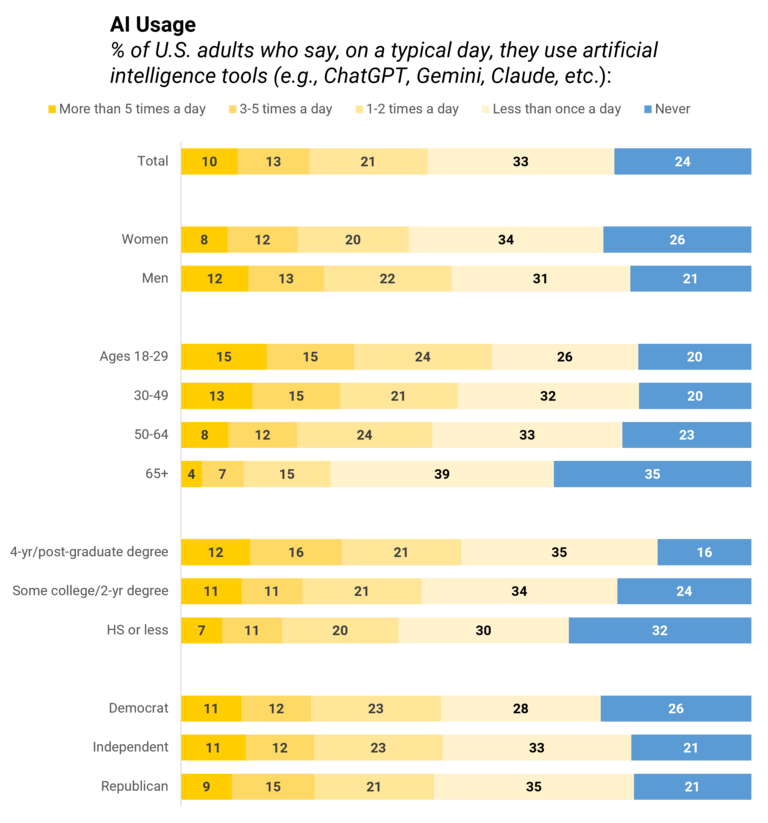
AI use is common, especially among younger adults and those with higher levels of education
Seventy-six percent of respondents reported using AI tools at least occasionally on a typical day, while 24% said they never use AI.
About 80% of adults ages 18–29 and 30–49 reported using AI, compared with 65% of adults ages 65 and older. Fifteen percent of adults ages 18–29 reported using AI more than five times a day.
Eighty-four percent of adults with a four-year or postgraduate degree reported at least some AI use, compared with 68% of those with a high school education or less.
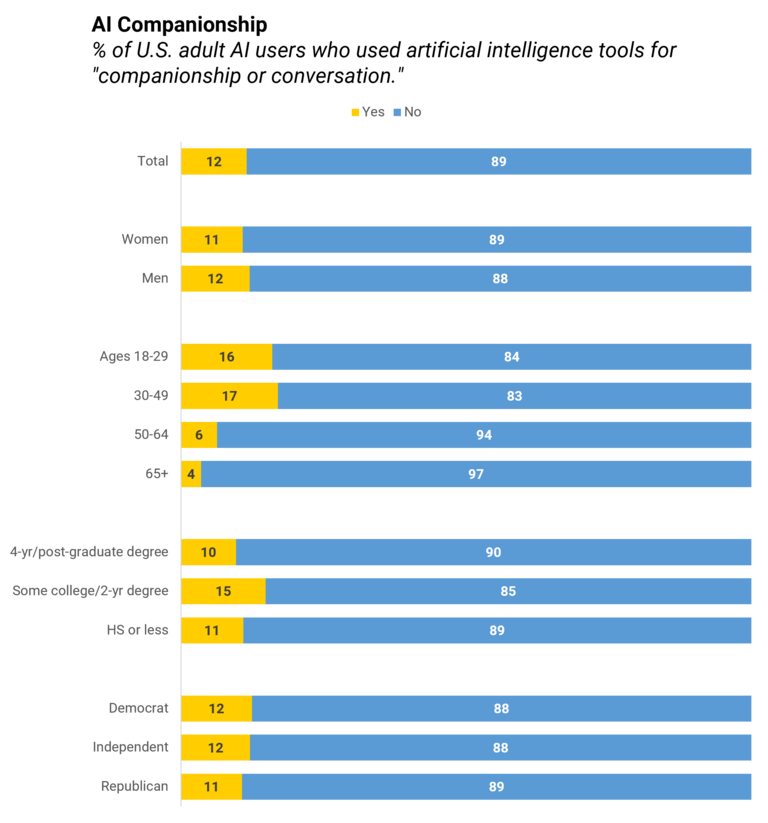
Younger AI users are more likely to use tools for companionship or conversation
Twelve percent of AI users reported using AI tools for “companionship or conversation.”
Use for companionship or conversation was highest among adults ages 18–29 (16%) and 30–49 (17%), and lowest among adults ages 50–64 (6%) and 65 and older (4%).
AI companionship use was similar among men and women and across political affiliation.
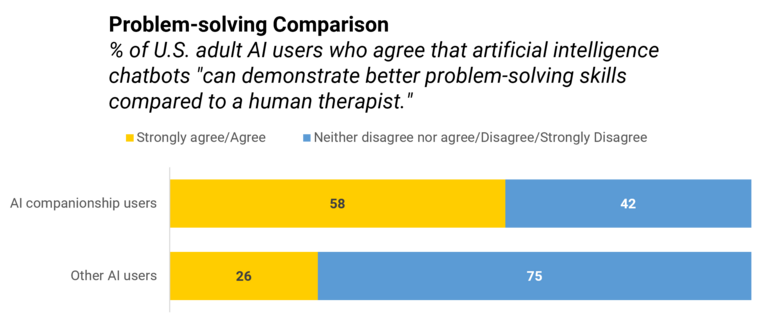
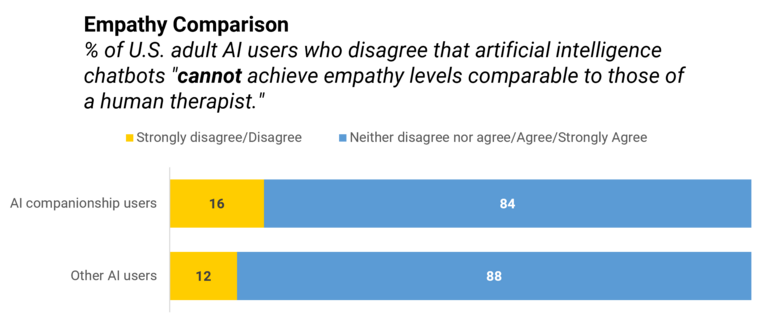
AI companionship users view chatbots differently than other AI users regarding problem-solving and empathy
People who use AI for companionship or conversation were more likely than other AI users to believe chatbots could demonstrate better problem-solving skills than a human therapist. Nearly 58% of AI companionship users agreed, compared with about 26% of other AI users.
At the same time, 16% of AI companionship users disagreed with the statement that AI chatbots cannot achieve empathy comparable to a human therapist. Among other AI users, 12% disagreed with the statement.
“We were surprised that nearly 6 in 10 people who use AI for companionship thought AI was better at solving problems than a human therapist,” said Kim, who led the survey. “Even though most didn’t think AI could understand their feelings as well as a human therapist could.”
Kim’s research team further explored these findings by examining the association between AI companionship use with other outcomes, such as loneliness, sleep difficulties, and depressive symptoms. This research is currently under peer review for publication.
Add your questions to a national survey
University of Iowa researchers can investigate their own research questions through CSSI's SurveyHarvest. The CSSI team handles human subjects compliance, survey programming, and coordination with the survey panel vendor.
AI Usage
% of U.S. adults who say, on a typical day, they use artificial intelligence tools (e.g., ChatGPT, Gemini, Claude, etc.):
| Category | More than 5 times a day | 3-5 times a day | 1-2 times a day | Less than once a day | Never |
| Total | 10 | 13 | 21 | 33 | 24 |
| Women | 8 | 12 | 20 | 34 | 26 |
| Men | 12 | 13 | 22 | 31 | 21 |
| Ages 18-29 | 15 | 15 | 24 | 26 | 20 |
| 30-49 | 13 | 15 | 21 | 32 | 20 |
| 50-64 | 8 | 12 | 24 | 33 | 23 |
| 65+ | 4 | 7 | 15 | 39 | 35 |
| 4-yr/post-graduate degree | 12 | 16 | 21 | 35 | 16 |
| Some college/2-yr degree | 11 | 11 | 21 | 34 | 24 |
| HS or less | 7 | 11 | 20 | 30 | 32 |
| Democrat | 11 | 12 | 23 | 28 | 26 |
| Independent | 11 | 12 | 23 | 33 | 21 |
| Republican | 9 | 15 | 21 | 35 | 21 |
AI Companionship
% of U.S. adult AI users who used artificial intelligence tools for "companionship or conversation."
| Category | Yes | No |
| Total | 12 | 89 |
| Women | 11 | 89 |
| Men | 12 | 88 |
| Ages 18-29 | 16 | 84 |
| 30-49 | 17 | 83 |
| 50-64 | 6 | 94 |
| 65+ | 4 | 97 |
| 4-yr/post-graduate degree | 10 | 90 |
| Some college/2-yr degree | 15 | 85 |
| HS or less | 11 | 89 |
| Democrat | 12 | 88 |
| Independent | 12 | 88 |
| Republican | 11 | 89 |