The University of Iowa’s Center for Social Science Innovation (CSSI) in the Office of the Vice President for Research (OVPR) selected three faculty members as 2026 awardees of its Summer Researcher-in-Residence program, which supports impactful, social science research addressing pressing social, civic, and health-related challenges.
The 10-week program provides awardees with dedicated offices, financial support, and access to CSSI’s research expertise and infrastructure. The program also includes weekly accountability meetings and workshops to learn how to effectively fund, sustain, and broadcast their research.
This year’s researchers represent disciplines spanning nursing, social work, and journalism, with projects focused on diabetes management in rural communities, suicide loss survivors, and generative artificial intelligence. Awardees plan to use their research funds to support graduate research assistants and to utilize CSSI’s survey and qualitative research services.
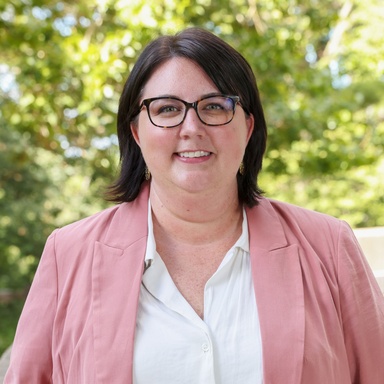
Feasibility of a Mobile App Delivered Mind-Body Physical Activity Intervention for Rural Older Adults with Type 2 Diabetes
Chelsea Howland, assistant professor, College of Nursing
Rural older adults with type 2 diabetes (T2D) face psychosocial barriers and limited access to care that worsen blood sugar control and increase risk of functional decline. Mind-body interventions address psychosocial barriers; mobile app delivered interventions bridge access to care barriers. mActive for Life is a mind-body biofeedback physical activity intervention design for rural older adults with T2D, delivered via mobile app. This study will pilot mActive for Life among rural adults aged 55 – 75 with T2D, evaluating feasibility, acceptability and fidelity to prepare for a future fully powered efficacy trial.

Caught between emotions: Understanding ambivalence among suicide loss survivors
Haelim Jeong, assistant professor, social work, College of Liberal Arts and Sciences (CLAS)
When someone dies by suicide, the lives of those left behind are deeply affected. Suicide loss survivors are individuals who have lost a loved one to suicide. Prior research shows that loss survivors experience conflicting emotions toward the deceased, contributing to an ambivalent psychological state. This qualitative study aims to explore how ambivalence is experienced and described among suicide loss survivors and how it manifests in their grieving process. The goal of the study is to develop a framework to enhance postvention efforts and better support the community of loss survivors.

AI Slop’s Impact on Political Trust and Decision-Making
Bingbing Zhang, assistant professor, journalism and mass communication, CLAS
The rise of generative AI has introduced vast amounts of low-quality or repetitive political content, often referred to as AI slop, into social media feeds and online platforms. This project examines how exposure to AI slop influences citizens’ perceived political knowledge, trust in credible information sources, and confidence in civic decision-making. Using a survey of U.S. adults, the study will measure self-reported exposure to AI slop, reliance on AI for political information, and perceptions of credibility. It will also assess whether AI literacy, media literacy, and prior political attitudes moderate these effects. Findings will inform strategies for enhancing political communication and democratic engagement in the AI era.
Additional Information
- Learn more about the Summer Researcher-in-Residence Program.
- Read how the 2025 cohort of CSSI’s Researcher-in-Residence program advanced their work over five weeks.
- Subscribe for emails about CSSI news and opportunities in support of social science research, including the Summer Researcher-in-Residence program.